
What international buyers need to know about buying in Sicily
Sicily is legally open to international buyers, including US and UK citizens, with no nationality restrictions whatsoever. The average asking price across the island sits at €1,169 per square meter as of April 2026, roughly half what you’d pay in Tuscany. That gap alone explains why Sicily keeps climbing the list for Americans looking at European property.
Before anything else, you need an Italian Tax Identification Number, the Codice Fiscale. The Italian Tax Agency issues it within about one day, either at a local office or through an Italian consulate abroad. No Codice Fiscale means no purchase, period.
Property types available to foreign buyers:
- Urban apartments in city centers (Palermo, Catania, Siracusa)
- Coastal villas and seaside apartments (Taormina, Cefalù, Trapani)
- Rural farmhouses and countryside properties (Enna, Caltanissetta, inland areas)
- Historic palazzos and Baroque townhouses in heritage centers
- New-build developments near major transport hubs
Price range snapshot: Provincial averages range from €627/m² in Caltanissetta to €1,318/m² in Palermo. Coastal premium towns like Taormina sit well above the island average. Inland villages can drop below €1,000/m², and abandoned properties list even lower, though renovation costs change the math significantly.
How do current Sicily property listings compare by location and type?
The spread between Sicily’s cheapest and most expensive markets is wider than most buyers expect. Three property types capture the range well.
| Property | Location/Province | Type | Bedrooms/Bathrooms | Price Range | Key Features |
|---|---|---|---|---|---|
| Typical urban apartment in Palermo | Palermo province | City flat | 2–3 bed / 1–2 bath | under €100,000 | Historic center access, rental income potential, near Falcone-Borsellino Airport |
| Coastal villa near Taormina | Messina province | Detached villa | 3–5 bed / 2–3 bath | €400,000+ | Sea views, resort amenities, high short-term rental demand |
| Country farmhouse in Enna province | Enna province | Rural detached | 3–5 bed / 1–2 bath | €25,000 to over €100,000 | Large land plots, renovation potential, traditional Sicilian architecture |
A typical urban apartment in Palermo gives you the best combination of price and city lifestyle. Palermo commands the island’s highest average at €1,318/m², but urban apartments still price well below comparable Italian cities. Proximity to the airport, a dense rental market, and genuine cultural amenities make this the most practical entry point for buyers who want both lifestyle and income.
The coastal villa near Taormina sits at the opposite end. Messina province’s premium resort corridor attracts buyers who want exclusivity, and the short-term vacation rental market there is among the strongest in southern Italy. The trade-off is price: quality villas with genuine sea views rarely appear below €400,000, and full renovation of an older property adds considerably to that figure.
Country farmhouses in Enna province offer the most land for the least money. Enna is one of Sicily’s most affordable inland provinces, and buyers regularly find detached properties with multiple hectares of land for under €100,000 asking price. The catch is infrastructure: water access, road connections, and utility hookups require verification before any offer.
What drives price variation across the island:
- Coastal proximity adds a consistent premium over inland equivalents
- Palermo and Catania attract urban buyers; Siracusa blends history with sea views
- Trapani offers coastal living at mid-range prices, with median values around €1,000/m²
- Inland provinces like Caltanissetta average €627/m², among the lowest in all of Italy
- Transportation access matters: Sicily has four international airports (Palermo, Catania, Trapani, Comiso)
Pro Tip: Check OpenStreetMap or Google Maps satellite view before visiting any rural property. Road access and proximity to utilities are not always disclosed upfront, and a property that looks close to a town on paper can require a significant drive on unpaved tracks.
How do you actually buy property in Sicily as a foreigner?
The buying process typically runs 2–6 months from accepted offer to completed title transfer. Inheritance complications or missing documentation push that timeline further. Here are the core stages:
- Obtain your Codice Fiscale from the Agenzia delle Entrate or an Italian consulate. Takes roughly one day.
- Commission a Geometra survey before signing anything. This licensed surveyor verifies cadastral records, building permits, and legal compliance, flagging unauthorized construction or amnesty issues.
- Make a formal offer through your estate agent. Once accepted, both parties move to the preliminary contract.
- Sign the Compromesso (preliminary contract) and pay a deposit of 10–20% of the purchase price. This contract is legally binding on both sides.
- Notary due diligence covers ownership history, outstanding debts, mortgages, and planning confirmations.
- Sign the Rogito (final deed) before the notary. The notary registers the property in your name immediately after.
What does it actually cost beyond the purchase price?
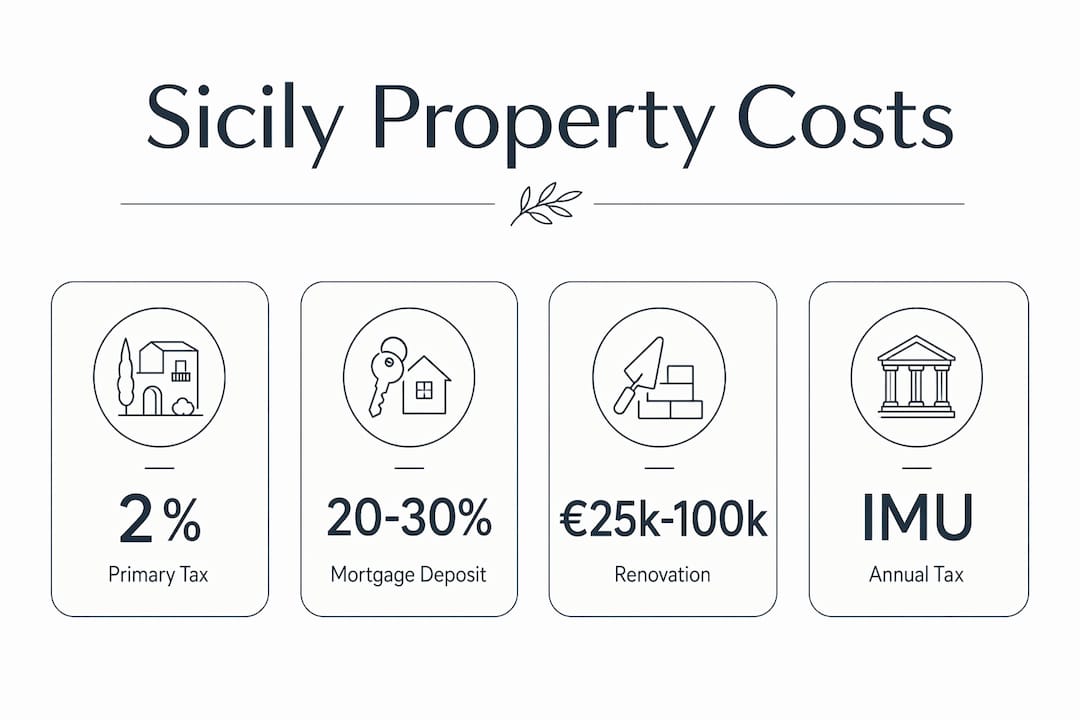
Budget an additional 10–15% of the purchase price for all associated fees and taxes. The breakdown:
| Cost Item | Rate |
|---|---|
| Purchase tax, primary residence | 2% of cadastral value |
| Purchase tax, second home | 9% of cadastral value |
| Notary and legal fees | 2–4% of purchase price |
| Estate agent commission | 3–5% of purchase price |
| Geometra surveyor fee | ~1% of purchase price |
Non-resident buyers can apply for an Italian mortgage, though lenders typically require a deposit of 20–30%. Currency risk is real for US buyers paying in euros: using a specialist foreign exchange service rather than a bank transfer can save a meaningful amount on larger transactions.

Pro Tip: Never skip the Geometra survey to save time or money. Many Sicilian properties carry irregularities from historical amnesty laws, and discovering unauthorized construction after the Compromesso is signed puts your deposit at risk.
Key legal insights US buyers often miss
Ownership and residency are entirely separate under Italian law. Buying property in Sicily does not grant residency rights, and residency is not required to own. US buyers who plan to spend extended time in Italy need a visa or residency permit regardless of what they own.
The Compromesso deserves more attention than most buyers give it. If you default after signing, you forfeit the full deposit. If the seller defaults, they must return your deposit plus an equivalent penalty. That protection sounds reassuring, but recovering money through Italian courts takes time. The better protection is thorough due diligence before you sign, not after.
Building amnesty is Sicily’s most common legal complication. Decades of construction without formal permits, later regularized through government amnesty programs, means many properties carry a complex paper trail. A Geometra confirms whether a property’s amnesty status is clean. Properties that cannot be brought into compliance cannot be legally renovated, which makes this check non-optional.
Critical buyer safeguards checklist:
- Confirm the Geometra has verified cadastral registration and building compliance
- Check for outstanding liens, debts, or mortgages through the notary search
- Verify utility access: water, electricity, drainage, and road access for rural properties
- Confirm inheritance chain is clean, especially for older or abandoned properties
- Engage an independent lawyer (avvocato) alongside the notary for complex transactions
Renovation costs range from €25,000 for light work to over €100,000 for structural renovation. Off-grid conversion for rural properties adds €12,000–€30,000. Buyers drawn to low-priced abandoned homes frequently underestimate these figures. The purchase price is only the beginning of the budget conversation.
Ongoing ownership costs include the IMU local property tax, utility contracts in your name, and professional property management in Italy if you are not resident. These are predictable costs, but they require planning before you complete the purchase, not after. For a full breakdown of what you’ll owe annually, the Italian property tax framework is worth reviewing in detail before you finalize your budget.
Livingitaly works differently from a traditional Sicilian agent
Most international buyers arrive in Sicily with a shortlist from a listing portal and a local agent who represents the seller. That structure works for straightforward purchases in familiar markets. Sicily’s legal complexity, amnesty history, and infrastructure variables make it a different situation.
Livingitaly works exclusively on the buyer’s side. The firm handles property finding and buyer advisory for US and UK clients, covering the full process from initial search through legal due diligence, tax planning, and post-purchase management. Where a seller’s agent is motivated to close the deal, Livingitaly’s mandate is to protect your position at every stage. For buyers considering Sicily as an investment rather than a primary residence, the firm’s advisory covers SPV structuring, rental yield analysis, and long-term asset management alongside the acquisition itself.
Key Takeaways
Sicily’s real estate market is legally open to US buyers, affordable relative to mainland Italy, and genuinely rewarding for buyers who prioritize due diligence over speed.
| Point | Details |
|---|---|
| No nationality restrictions | US and UK citizens can buy Sicilian property with the same rights as Italian citizens. |
| Codice Fiscale is mandatory | Obtain this Italian tax ID from the Agenzia delle Entrate or a consulate before any transaction. |
| Budget 10–15% above purchase price | Taxes, notary fees, agent commissions, and surveyor costs add up quickly. |
| Geometra survey is non-optional | Building amnesty irregularities are common; skipping this check risks your deposit and legal title. |
| Livingitaly represents buyers only | The firm covers property finding, legal due diligence, tax planning, and management for international clients. |