
Northern Italy offers economic stability, strong infrastructure, and a higher-priced but lower-risk property market. Southern Italy delivers lower entry costs, authentic lifestyle appeal, and meaningful long-term appreciation potential, particularly in tourism-driven regions. For US investors, the choice between the two comes down to one question: are you optimizing for yield stability or capital growth?
Here is what the data shows. Unemployment in Sicily runs at 17% compared to just 2% in Bolzano-Bozen Province in the North, as of Q2 2022. That gap tells you something important about rental demand stability, tenant quality, and the economic engine behind each region’s property market.
Northern Italy at a glance:
- Higher property prices, lower vacancy risk, and stronger long-term demand from urban professionals
- Superior road, rail, and public transit infrastructure improving property accessibility
- Industrial and tech economy anchored in Milan, Turin, and Bologna
- Lower rental yields but more predictable income streams
Southern Italy at a glance:
- Lower acquisition costs with stronger potential for capital appreciation
- Tourism-driven rental demand, particularly in Puglia, Sicily, and the Amalfi Coast
- Slower bureaucratic processes and greater need for local expertise
- Higher reward potential paired with higher management complexity
Livingitaly works with US buyers across both regions, providing the kind of on-the-ground advisory that turns these broad contrasts into a concrete acquisition plan.
Table of Contents
- How economic disparities between North and South shape your investment risk
- What cost of living differences mean for your rental strategy
- How your investment goals should drive the North vs South decision
- How Livingitaly’s regional expertise gives US investors a real edge
- Key Takeaways
How economic disparities between North and South shape your investment risk
Northern Italy’s 2021 GDP reached an estimated €1.0 trillion, accounting for 56% of the entire Italian economy despite holding just 46% of the population. That concentration of output matters directly to property investors: it signals deep, durable demand for housing, commercial space, and rental units in cities like Milan, Verona, and Bologna.
The South tells a different story. In 2019, Lombardia’s per capita GDP stood at €39,700 versus Calabria’s €17,300, a gap that has barely closed since the 1930s. Productivity differences and inter-regional fiscal transfers together account for more than 70% of that income disparity.
| Indicator | Northern Italy | Southern Italy |
|---|---|---|
| Unemployment (example provinces, Q2 2022) | 2% (Bolzano-Bozen) | 17% (Sicily) |
| Per capita GDP (2019, example regions) | €39,700 (Lombardia) | €17,300 (Calabria) |
| Share of national GDP (2021) | 56% | Significantly lower |
| Rental demand driver | Urban professionals, industry | Tourism, seasonal visitors |
| Investment risk profile | Lower risk, stable returns | Higher risk, higher upside |
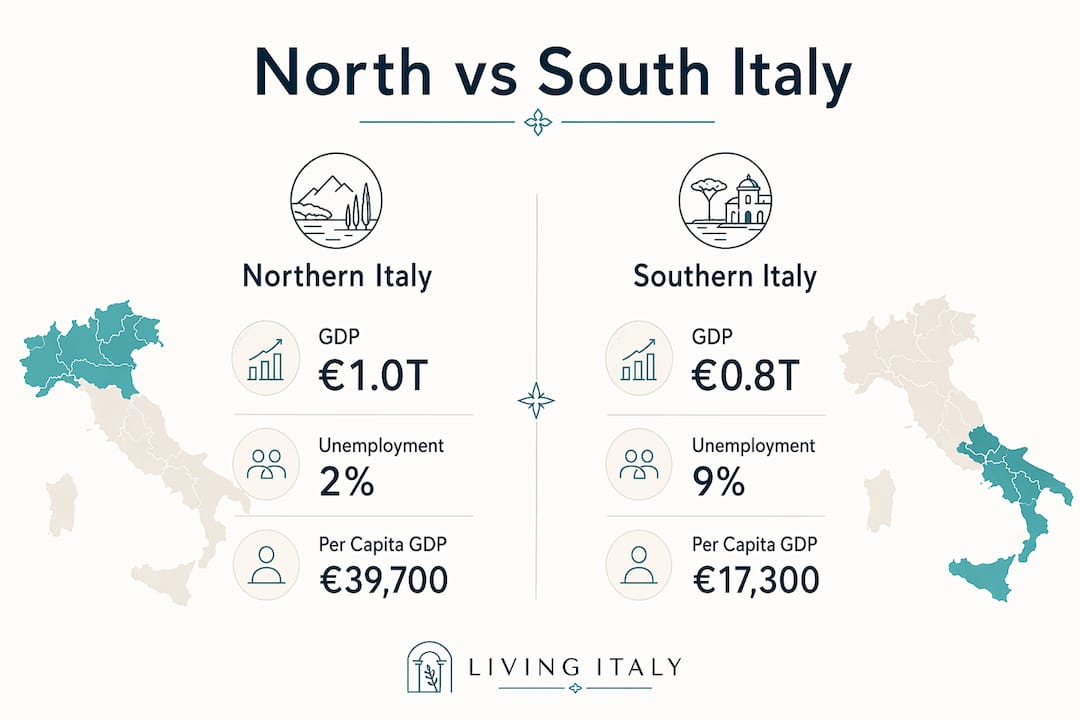
One nuance worth knowing: Italy’s regional divide is not simply a binary North-South split. Researchers identify multiple distinct sub-regions within the South itself, each with different development trajectories. Puglia behaves differently from Calabria; coastal Sicily differs from its interior. Treating the South as a monolith is one of the most common mistakes US investors make.
The North-South labor productivity gap is driven primarily by differences in regional productive structures, not by institutional failures or policy gaps. That distinction matters for investors: it means the South’s challenges are structural and long-term, not easily reversed by a single government program or infrastructure project.
What cost of living differences mean for your rental strategy
Cost of living, including accommodation, restaurants, and general expenses, runs higher across Northern Italy than in the South. For investors, that cuts both ways.
In the North, higher operating costs mean higher rents, which supports stronger nominal income from long-term residential lets. Milan, in particular, draws a steady stream of corporate tenants, students, and expats willing to pay premium rates. The trade-off is a higher acquisition price and thinner yield margins.
Northern Italy cost and lifestyle factors for investors:
- Higher property purchase prices, especially in Milan, Venice, and Lake Como
- Strong year-round rental demand from professionals and students
- Higher property management costs and service charges
- Urban lifestyle appeals to long-term tenants seeking career opportunities
Southern Italy cost and lifestyle factors for investors:
- Lower entry prices create room for stronger gross yields
- Real purchasing power in the South can exceed the North due to lower price levels for housing and services, despite similar nominal wages nationally
- Tourism-driven short-term rental income can be significant but is seasonal
- Lifestyle appeal to international buyers seeking authenticity, warmth, and slower pace
The South’s slower rhythm is not just a cultural footnote. It shapes tenant profiles, lease structures, and the type of management your property will require. A Puglia trullo rented to European vacationers in July and August needs a completely different management approach than a Milan apartment leased to a finance professional on a two-year contract. Both can work well; they just require different systems and local knowledge.
For a detailed breakdown of regional financial considerations including taxes and acquisition costs by area, the specifics vary enough between North and South that generic guidance rarely holds.
How your investment goals should drive the North vs South decision
The most useful frame for this decision is not “which region is better” but “which region fits what I am trying to build.” Investors who have worked through this with Livingitaly consistently find that clarity on three priorities resolves most of the ambiguity.
Infrastructure and accessibility: Northern Italy’s road network and signage are generally superior, making property management more straightforward, especially for investors managing remotely from the US. Southern regions, particularly rural Puglia, Basilicata, and inland Sicily, often require a car and local contacts to manage effectively. That is not a dealbreaker, but it is a real operational consideration.

Economic stability vs. appreciation potential: The North suits investors who prioritize predictable income and lower vacancy risk. The South suits those willing to accept more variability in exchange for lower entry costs and the possibility of stronger capital appreciation as tourism infrastructure and demand continue to develop.
Lifestyle and rental market type: Northern Italy’s economy leans on industry, technology, and services, which drives demand for long-term residential and commercial lets. Southern Italy’s tourism and agricultural base creates a market dominated by short-term vacation rentals, with all the seasonality that implies.
- Investors targeting stable, long-term residential income: Northern Italy, particularly Lombardy, Veneto, and Emilia-Romagna
- Investors targeting vacation rental income and lifestyle value: Southern Italy, particularly Puglia, Sicily, and Campania
- Investors seeking a blend of lifestyle appeal and relative stability: Tuscany, which straddles the cultural divide
Pro Tip: Before committing to a region, ask Livingitaly to map your specific income targets against realistic yield ranges for the property types you are considering. The gap between a Milanese apartment’s gross yield and a Puglia villa’s peak-season short-term rental income is often smaller than investors expect, once management costs and seasonality are factored in.
The area-specific buying guides available for different Italian regions are a useful starting point for understanding how cost and investment dynamics shift at the local level.
How Livingitaly’s regional expertise gives US investors a real edge
Livingitaly operates as a buyer-side advocate, not a traditional agency. That distinction is significant: the firm’s mandate is to protect the buyer’s interests through every stage of the transaction, from initial property identification through legal due diligence, tax structuring, and long-term management.
For investors comparing North and South, Livingitaly’s regional specialization is the practical advantage. The firm runs dedicated advisory practices under Living Tuscany, Living Apulia, and Living Sicily, each staffed with on-the-ground expertise specific to those markets. That means local legal contacts, knowledge of regional bureaucratic processes, and relationships with trusted renovation contractors, all of which matter enormously when you are buying from the US.
Core services Livingitaly provides across both regions:
- Property search and shortlisting aligned to your investment criteria
- Legal due diligence, title checks, and contract review
- Tax planning and SPV or corporate structuring where appropriate
- Visa and residency assistance for buyers seeking Italian residency
- Renovation project management for properties requiring restoration
- Long-term property and rental management post-acquisition
The firm’s buyer advisory services are structured to cover the full acquisition lifecycle, which matters particularly for US buyers who cannot be on the ground in Italy during the process. Livingitaly’s first-hand research into specific properties and markets means clients are not relying on listing descriptions or agent-supplied comparables.
For investors specifically focused on Italy real estate investment strategy, the firm’s advisory goes beyond transaction support to include portfolio-level thinking: which region fits your risk tolerance, what structure minimizes Italian tax exposure, and how to build a property that performs over a ten-year horizon rather than just in year one.

Whether you are drawn to the economic depth of the North or the lifestyle upside of the South, the decision deserves more than a general comparison. Livingitaly’s team works with you to match your specific goals to the right region, the right property type, and the right legal and tax structure. Reach out to start a conversation.
Key Takeaways
Northern Italy offers economic stability and lower investment risk; Southern Italy offers lower entry costs and stronger appreciation potential for investors who can manage the complexity.
| Point | Details |
|---|---|
| Unemployment gap is wide | Sicily’s 17% unemployment vs. Bolzano-Bozen’s 2% (as of Q2 2022) signals very different rental demand profiles. |
| Northern GDP dominates | Northern Italy generates 56% of Italy’s GDP with 46% of its population, underpinning stable property demand. |
| Southern purchasing power | Lower price levels in the South can equalize real purchasing power despite lower nominal wages. |
| Per capita GDP gap | Lombardia’s €39,700 per capita GDP versus Calabria’s €17,300 reflects structural, long-term economic divergence. |
| Regional advisory matters | Livingitaly’s dedicated practices for Tuscany, Apulia, and Sicily give US buyers on-the-ground expertise in each market. |